Short answer
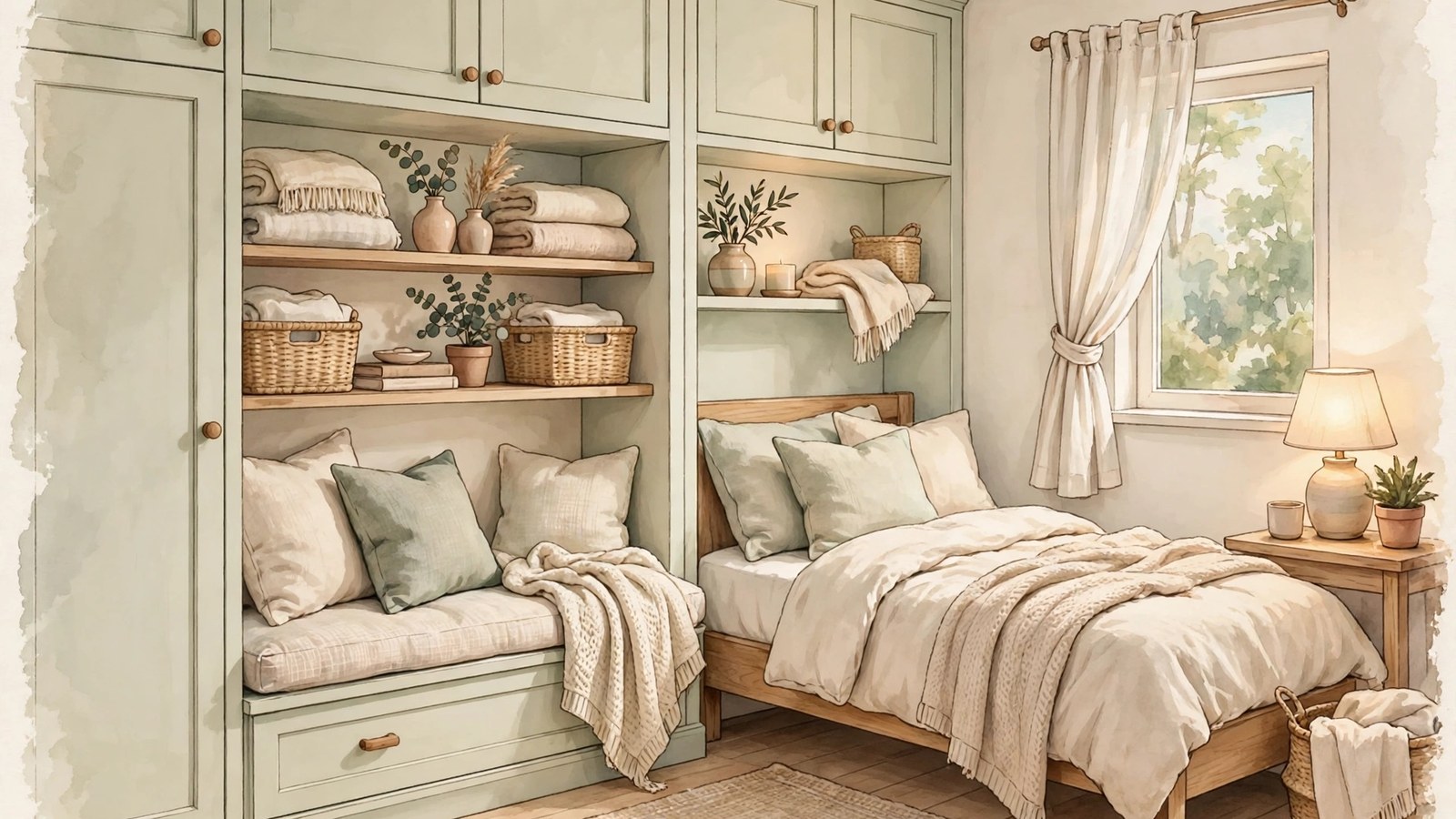
- Compact bedroom ideas work best when you treat the room as one system. Choose the smallest bed that still lets you sleep comfortably, place it against the longest wall or in a corner, and keep one clear walking path from the door to the bed and the closet or wardrobe. Use the space the room already has before adding furniture: under the bed for seasonal clothes and spare bedding, the back of the door and the inside of wardrobe doors for accessories, the height inside the wardrobe for stacked bins and tiered hangers, and the top of the wardrobe for light items you rarely use. For storage that needs no drilling, rely on removable hooks, over-door organizers, tension rods for light items only, leaning or freestanding shelves, and a rolling rack kept to a small weekly selection. Keep everyday items within easy reach and rarely used items in harder to reach places. Light colors, a mirror placed to reflect daylight, light window coverings, and layered lighting make the room feel larger, and furniture on legs keeps more floor visible. Declutter before you buy storage, measure before you buy furniture, and respect weight limits on hooks and rods.
Introduction
A small bedroom has to do a lot of work. It is where you sleep, get dressed, store clothes, and often work or study as well. Handled badly, it feels like a hallway with a bed pushed into it. Handled well, the same room feels calm, private, and surprisingly spacious, even though the floor area has not changed at all.
This guide gathers compact bedroom ideas for people who own or rent a small bedroom. Most of the ideas need no drilling, no building work, and no landlord permission. The few that do involve fixings are flagged clearly, so you can check your lease first. The order matters as much as the individual tips. Start with the bed, then use the storage space the room already contains, then deal with layout, color, and light, and only then consider buying anything new. Readers who clear out what they no longer need before buying organizers usually find that they need far less new storage than they expected.
Start With the Bed
The bed is the largest object in the room, so it decides almost everything else. Get the bed right first and the rest of the room becomes much easier to arrange.
Choose the right size, not the largest size. In the United States, a twin mattress is about 38 by 75 inches, a full or double is about 54 by 75 inches, a queen is about 60 by 80 inches, and a king is about 76 by 80 inches, with small variations of about an inch between brands. Those numbers explain why a king can overwhelm a small room: it is twice as wide as a twin and leaves little floor for dressing or storage. A full often suits a couple in a small room better than a queen, and a twin or a full often gives a single sleeper the best balance of comfort and floor space. Measure the room, subtract the bed footprint, and check what is left for a walking path before you commit to a size.
Push the bed into a corner or against the longest wall. A bed floating in the middle of a small room wastes usable floor on both sides. Against a wall, you gain one continuous stretch of floor for dressing and moving around. A corner position can also create a defined sleeping nook that feels deliberate rather than cramped, although it does make changing the sheets on the wall side a little slower.
Raise the bed, or choose storage built into it. A frame with drawers underneath turns the largest unused footprint in the room into storage for bedding, shoes, or out-of-season clothes. If you already own a bed, risers can lift it enough for low, flat containers underneath. Measure the clearance first, and check that the raised bed stays stable and is still easy to get into and out of safely.
Keep the bedding simple. A bulky bedspread and a pile of decorative pillows take up visual space and tend to end up on the floor every night. A plain duvet, two pillows, and one throw are easier to make up, easier to wash, and make the bed look neater, which matters in a room where the bed dominates the view.
Give each side of the bed only what it needs. If only one side is reachable, do not force a bedside table into a gap it does not fit. A fabric pocket organizer beside the mattress, or a clip-on shelf, can hold a phone, a book, and glasses without using any floor space.
Storage Ideas That Do Not Need Drilling
Renters often assume they cannot add storage without putting holes in walls. In practice, some of the most effective compact bedroom ideas need no fixings at all, and owners who prefer not to drill can use the same methods.
Use removable hooks for a drop zone. A small group of removable hooks near the door gives bags, hats, and the outfit for tomorrow a fixed home, instead of letting them migrate to the bed or the floor. A tray or a small basket in the same spot catches keys, glasses, and chargers. Follow the manufacturer instructions for weight limits and removal, and test one hook in an inconspicuous spot first if you are unsure how it will affect your paint.
Use a rolling garment rack for overflow, carefully. If the closet or wardrobe is full, a slim rolling rack can hold daily wear where you can see it. It works best as a short, curated rail, such as the outfits for the week ahead or work clothes only. Used as a second full wardrobe, it quickly starts to look like clutter and blocks walking paths.
Lean, do not mount. A leaning ladder shelf stands against the wall under its own weight and holds folded blankets, books, or plants. A tall, narrow freestanding bookcase or cabinet does the same job with more stability and can hide clutter behind closed doors. Both give you vertical storage without touching the wall itself. Follow the manufacturer safety guidance for tall furniture, and do not overload the top shelves.
Try tension rods in awkward gaps. A tension rod wedged between wardrobe sides, between shelves, or across a narrow recess adds hanging space with no screws and nothing permanent. Treat it as a spare rail for light garments only. It cannot stand in for fixed hardware, and loading it heavily will pull it down.
Use the inside of wardrobe doors. Removable hooks or a slim hanging organizer on the inside of a wardrobe door holds belts, scarves, jewelry, and small accessories without adding anything visible to the room. Reserve it for items you reach for regularly, so the space earns its place.
Use the back of the door. An over-door rail or organizer puts a surface that otherwise does nothing to work, holding a robe, the outfit for tomorrow, bags, and accessories. Check that the door still closes properly and that the organizer does not rub the frame. Keep the selection short, because a door crowded with belongings soon looks messier than the room it was meant to tidy.
If you do want fixed shelves, check your lease first. Advice in the source guides is qualified on this point, and this article keeps that qualification: some landlords allow small fixings if holes are filled when you move out, but practice varies, so ask rather than assume. Removable alternatives now cover most needs anyway.
Under-Bed and Vertical Storage
Two zones do most of the heavy lifting in a compact bedroom: the space under the bed and the space above your head.
Under the bed is often the largest unused storage zone in a small bedroom. Low, flat boxes or soft zippered bags suit seasonal clothes, spare bedding, and items you use rarely. Choose containers that fit the actual clearance beneath your bed rather than the biggest containers available, and use matching containers so the area looks intentional when it is glimpsed. Lids help when clothes or linens will sit there for months, and simple labels save you from pulling every container out to find one item. Keep everyday essentials elsewhere, because reaching under the bed every morning gets old fast.
Inside the wardrobe or closet, stack upward. Shelf inserts and stackable bins use the height of tall shelves that otherwise leave empty air above folded clothes. Tiered hangers that drop one garment below another let shirts and light layers share the height of a single hook position, so the rail holds more without any new furniture. Slim, matching hangers also free a surprising amount of rail space compared with a mix of bulky hanger styles.
Above the wardrobe is useful for light, bulky items you need only rarely: luggage, spare bedding, and off-season clothes in matching boxes or zippered bags. Anything heavy belongs lower down, where you can lift it without stretching or climbing.
Beside the bed, a fabric pocket that slips beside the mattress turns an unusable sliver of space into a place for a phone, glasses, and a book. It is especially handy where the bed sits hard against the wall and a table will not fit.
Above the bed, if your lease allows fixings, a single shelf or a row of picture ledges uses wall space without touching the floor. Keep anything heavy off shelves above where you sleep. If drilling is not allowed, a tall headboard with built-in shelving, or a freestanding shelf unit behind the bed, achieves a similar effect.
The rule for all of these zones is the same. Store rarely used things in hard to reach places, and keep everyday things where you can grab them without moving other items first. If you have to shift five things to reach one, the system needs simplifying.
Small Bedroom Layouts That Work
A small bedroom usually has one layout that works well, and finding it is worth an hour of experimenting before you buy anything.
Bed against the longest wall, wardrobe on the shortest. This is the default that works in most small rooms. The bed takes the long wall, the wardrobe or chest of drawers takes a short wall or an alcove, and the remaining floor stays open for dressing and moving around.
Bed in the corner for very small rooms. When the room is barely bigger than the bed, a corner position frees the most floor area. It makes making the bed slightly harder, but the gained space is usually worth it, and a fitted sheet and a simple duvet keep bed making quick.
Wardrobe and closet doors need room to open. Sliding doors or a curtain front suit tight rooms better than hinged doors that need a clear swing arc. If you have hinged doors, check what they block when open. A door that hits the bed every morning is a layout problem, not a wardrobe problem. The same check applies to drawers, which need clear space in front to open fully.
Keep one clear path. You should be able to walk from the door to the bed and to the wardrobe without sidestepping furniture. If you cannot, something is in the wrong place or is too large, no matter how useful it seems on its own. The same test applies at the foot of the bed if you add a storage bench there: it is only useful if you can still walk past it comfortably.
Zone a work corner honestly. If you work or study in the bedroom, give that activity a defined corner, such as a small desk or a fold-down surface and a chair that tucks away, rather than letting a laptop take over the bed. Keeping work visually separate helps the room still feel like a place to rest.
Measure before buying, every time. Measure the room, the doorways, the hallway the furniture must pass through, and the space around the bed, including walking paths, before adding any new piece. The most common small bedroom mistake is buying storage furniture that does not fit the space it was bought for.
A Worked Example: Putting the Ideas Together
It helps to see the rules applied to one room. Imagine a small rental bedroom with one window, a reach-in closet with a hinged door, and just enough floor for a full bed, a small dresser, and a narrow walking path. Nothing in this example needs drilling.
First, the bed goes against the longest wall, positioned so the closet door can still swing open without hitting the frame. Under the bed, two matching low containers hold out-of-season clothes and a third holds spare bedding. Everyday items stay out of the under-bed zone entirely.
Second, the door becomes storage. An over-door organizer holds shoes and accessories, and two removable hooks beside the door form the drop zone for a bag and a hat. A small tray on the dresser holds keys and glasses, so daily items land in one place.
Third, the closet is reorganized upward. A hanging organizer adds shelves for folded clothes, stackable bins use the high shelf, and slim matching hangers replace a mixed set. Daily clothes hang at the front, within easy reach. Seasonal pieces move to the back and under the bed.
Fourth, the awkward corner by the window takes a tall, narrow freestanding shelf for books and a basket of accessories. Nothing heavy goes on its top shelves.
Finally, color and light finish the job. Bedding and curtains stay in one pale palette, a full length mirror reflects window light, and a warm bedside lamp replaces reliance on a single harsh ceiling light. The room has gained storage at the door, under the bed, in the closet, and in the corner, without a single new hole in a wall.
Color and Light Tricks
Color and light change how big a room feels, often more than any furniture change.
Light colors reflect light. Soft whites, pale grays, and pastels bounce daylight around the room and make walls feel farther away. That does not mean the room must be white. A single pale color across walls, bedding, and curtains, with darker accents in pillows or art, keeps the room calm without feeling clinical. Storage boxes in tones that match the room blend in rather than drawing the eye.
Use one color to soften boundaries. One color across walls, woodwork, and even the ceiling blurs the edges of the room, which can make it feel larger. This works best with a light or mid tone color. Darker colors can also work, but they need good lighting and lighter furniture and bedding to balance them.
Mirrors reflect light. A mirror opposite or beside the window reflects daylight and the view, and a mirrored wardrobe door does the same job while hiding storage. Keep mirrors clean, and be careful what sits in front of them, because a mirror reflecting a messy corner doubles the mess rather than the sense of space.
Keep window coverings light. Heavy curtains close a small room in. Light fabrics, sheer panels, or streamlined blinds let daylight through and keep the window area feeling open. A sheer layer gives daytime privacy without blocking much light.
Layer the lighting. A single harsh ceiling light flattens a small bedroom. A bedside lamp or a warm toned bulb in the main fitting lets you change the mood from bright and practical in the morning to soft and restful at night, which helps the room feel like a place to unwind rather than a place to work.
Keep the floor visible. Furniture raised on legs, a rug that does not cover the whole floor, and clear space visible under the bed frame all let you see more floor, which reads as more room. It is a small effect on its own, but in a compact bedroom the small effects add up.
Furniture Worth the Money
In a small bedroom, a few pieces genuinely earn a higher price because they replace other furniture or use space nothing else can reach. Spend on these, and save on the rest. Prices vary widely by material and size, so treat cost as a planning question for your own budget rather than as a fixed figure.
A storage bed. Drawers or a lift-up base turn the footprint of the bed into the largest storage zone in the room. If you buy one thing for a small bedroom, this is usually it. For renters who cannot replace the bed, low containers under an existing frame are the lower cost version of the same idea.
A good wardrobe, not a bigger one. A wardrobe or closet system that fits the room and uses its full height, with a mix of hanging space and shelving, beats a larger piece that blocks a walkway. Adjustable shelves and a double hang arrangement make a standard wardrobe far more useful.
A bedside solution that fits the gap. A narrow table, a small rolling cart, a wall shelf where allowed, or a bedside pocket organizer, whichever actually fits, is worth more than a matching pair of tables that crowd the bed. Buy for the gap you have, not the pair you pictured.
Good hangers and drawer dividers. Slim, matching hangers free rail space, and drawer dividers stop a drawer from becoming a single tangled layer. File folding, where folded clothes stand upright so you can see each item, also helps a drawer hold more in a usable way. Both fixes are inexpensive and make existing storage work harder.
A full length mirror. A mirror on a door, on the wardrobe, or freestanding in a slim frame serves a daily purpose and makes the room feel larger. A leaning mirror needs floor space; a door hung one does not.
What is rarely worth much: a bulky dressing table you use twice a month, a second chair that becomes a clothes pile, or decorative boxes that look tidy but hold nothing you need. If the main job of a piece is to look like storage, it is probably not storage.
A Simple Weekend Reset, Step by Step
A short, ordered reset shows how the rules fit together.
Step one is to clear out first. Remove anything that no longer needs to live in the room, including clothes you no longer wear and objects that belong elsewhere in the home. Do this before buying any organizer, so you organize only what you actually keep.
Step two is to measure. Note the room dimensions, the clearance under the bed, the closet or wardrobe shelf height and depth, the swing of every door, and the width of the walking path. Keep the numbers on your phone for any later purchase.
Step three is to assign one home to everything that stays. Bedding gets a container, shoes get one rack or organizer, accessories get a drawer section or the inside of a wardrobe door, and daily items get the drop zone. Items without a home end up on a chair or the floor.
Step four is to place items by how often you use them. Daily items go at waist to eye level or beside the bed. Weekly items go in drawers and lower shelves. Seasonal and rare items go under the bed and on high shelves, in labeled containers.
Step five is to finish with light and surfaces. Clear at least one surface completely, leave some wall space empty, and check the room in daylight and in lamplight. If it still feels crowded, the next fix is usually to remove one item, not to add another organizer.
Common Mistakes to Avoid
Buying storage before decluttering. New boxes and organizers feel productive, but if the room is full of things you no longer need, you are simply organizing clutter. Clearing out first is the highest value step, and it costs nothing.
Overloading no-drill solutions. Adhesive hooks and tension rods have weight limits. Overloaded, they fall down, damage paint, or both. Use them for light items only, and follow the manufacturer guidance.
Adding too much furniture. Every extra cabinet, shelf, or bench takes walking space. One well chosen multifunctional piece, such as a storage bed or a bench with hidden storage, usually beats three single purpose pieces.
Filling every wall and surface. A room where every wall holds a shelf and every surface holds an organizer feels busier, not better organized. Leave some empty wall and at least one clear surface. Empty space is part of the design.
Ignoring the top of the wardrobe. The space above a wardrobe that stops below ceiling height is easy to forget and easy to fill with random bags. Matching boxes make it look intentional; a jumble makes the whole room look untidy.
Choosing furniture for a future home. A wardrobe sized for a house you might move to punishes you daily in the room you actually have. Buy for this room, and let the next home have its own furniture.
Letting the chair become a wardrobe. A chair will collect clothes unless it has another real job. Give it a purpose, such as a reading chair with a lamp, or remove it and use the space for storage that closes.
Hiding everything in large, unlabeled containers. Big boxes become hard to manage when you cannot remember what is inside them. Label containers, group similar items together, and keep a little empty space in drawers so putting things away stays easy.
Frequently Asked Questions
What are the best compact bedroom ideas for a very small room?
Start with the bed size and position, because the bed controls the layout. A full or twin bed against the longest wall or in a corner, storage under the bed for seasonal items, an over-door organizer, and a drop zone by the door give the largest gain for the least change. Add vertical storage inside the closet or wardrobe next, and only add new furniture after measuring.
How can I add storage in a rented bedroom without drilling?
Use methods that need no fixings: removable hooks, over-door rails and organizers, tension rods for light items only, leaning or freestanding shelves and cabinets, a rolling garment rack, and low containers under the bed. Check your lease before using any fixing, and follow manufacturer weight limits and removal instructions for hooks and rods.
What should I store under the bed?
Store items you use rarely and that tolerate being out of daily reach: seasonal clothes, spare bedding, spare pillows, and occasional shoes or bags. Use low containers that fit the actual clearance, with lids for long term storage and labels so you can find things. Keep everyday essentials in drawers, the closet, or the drop zone instead.
What bed size works best in a small bedroom?
In United States sizes, a twin is about 38 by 75 inches and a full is about 54 by 75 inches, while a queen is about 60 by 80 inches and a king is about 76 by 80 inches. A full often balances comfort and floor space for a single sleeper or a couple in a small room. Choose the smallest size that still lets everyone sleep comfortably, and confirm the walking space left around it before buying.
How do I make a compact bedroom feel bigger without moving furniture?
Use light colors on walls and bedding, place a mirror where it reflects window light, switch heavy curtains for light fabrics or streamlined blinds, layer lighting instead of relying on one ceiling light, and keep as much floor visible as possible. Clearing clutter from surfaces and the floor has the same effect and costs nothing.
What if my bedroom has no closet?
Combine a freestanding wardrobe or a rolling garment rack for hanging clothes with under-bed containers for seasonal items, an over-door organizer for shoes and accessories, and a dresser or tall narrow shelf for folded clothes. Keep the rack to a limited selection so it does not become a permanent clothes pile, and place it where it does not block doors, windows, or the walking path.
Should I buy storage furniture or organize what I already have first?
Organize first. Clear out what you no longer need, use the door, the under-bed space, and the height inside the closet or wardrobe, and assign one home to everything that stays. Many small bedrooms need no new furniture after that. If a gap remains, measure it exactly and buy one piece that fits it, ideally one that serves two purposes.
Keep reading: Compact Living: Small-Space Ideas for Every Room
Keep reading: Free Printable Basic Rental Agreement
Sources & references
- Little Space Edit, "Small Bedroom Storage Without Drilling" (published 30 August 2026). Opened and checked 29 October 2026. Supports over-door rails for bags and robes, under-bed space as a large unused storage zone with low, flat containers matched to the actual clearance, storage inside wardrobe doors for accessories, tension rods as a light secondary rail, bedside pocket organizers, stacking upward inside wardrobes, storing seasonal pieces higher up, removable hooks for a drop zone, and clearing out before adding organizers.
- RentRevive, "Renter Friendly Bedroom Storage Ideas Without Permanent Changes" (published 23 August 2026). Opened and checked 29 October 2026. Supports under-bed containers for seasonal clothing and spare bedding, over-door organizers, freestanding vertical furniture and ladder shelves, slim cabinets and corner storage, closet organization with hanging organizers and matching hangers, dresser organization with dividers, shoe storage, a drop zone near the door for everyday items, keeping everyday items within easy reach, one home for everything, and clearing out before buying storage.
- B&Q, "25 small living room ideas" (diy.com, no publication date stated on the page). Opened and checked 29 October 2026. Used only as a cross-reference for the color and light section: light color palettes reflect light and make small rooms feel larger, mirrors opposite windows reflect daylight, furniture with legs shows floor underneath, layered lighting adds warmth and depth, light window dressings let daylight through, using one color across walls and ceiling softens boundaries, and dark colors need lighter elements to balance them.
- Amerisleep, "Mattress Sizes Chart and Dimensions Guide," and Casper, "Mattress Size Comparison Guide." Checked via search records 29 October 2026. Support the standard United States mattress dimensions used in this article: twin about 38 by 75 inches, full about 54 by 75 inches, queen about 60 by 80 inches, and king about 76 by 80 inches, with small variation between brands.


